![[DEFINE]: Our AI Futures](http://images.squarespace-cdn.com/content/v1/69c6d200c55e595fae9b42eb/cceee3eb-0a64-480a-a252-8300b82ce3ce/white_logo_edged.png?format=1500w)
Code speaks Quechua too!!!
Isabela Naty Sanchez Taipe
Dear future students,
This past spring during tutoring sessions, one of my senior high school students, Urpi, looked up
from her laptop and asked me, "Can I really write the buttons in Quechua?"
I smiled and said, "Arí, Urpicha!"(Yes, little Urpi!)
For years, I had learned computer science almost entirely in English. Every tutorial I watched on Youtube, every programming language, every UI design platform spoke only a handful of languages and Quechua, my mother’s first language, was not one of them.
Last year, I started online tutoring high school girls in Peru whose first language is Quechua.
I wanted to teach them HTML, CSS, and JavaScript, but I also wanted them to learn without feeling like they had to leave a part of themselves behind. So every week, before our sessions, I use AI to help me draft practice worksheets, create examples, and translate explanations into written Quechua. Quechua was my main language while growing up with my mom and sisters, but writing academic and technical material in Quechua is still challenging for me. AI gives me a starting point. Then I rewrite, ask my Mamay for feedback, rewrite again and adapt every lesson so it sounds like us.
Together, we are building something I never had when I was learning to code.
This summer, my students are creating their first websites. From the low-fidelity prototypes, to the code of the navigation menus, buttons, and welcome messages. Everything is written in Quechua. Every time we meet in zoom, I think about how different my own introduction to technology could have been if someone had told me that my language belonged here too.
As a designer, I heard multiple conversations about why AI should not be included in education settings. Nevertheless, during my experience tutoring and learning I realized AI did not build trust between my students and me. It did not celebrate with them when their first “Imaynallan pacha!”(Hello world!) It did not hear the excitement in their voices when they realized they could write code without leaving their identity at the door.
We, the humans in our virtual classroom, did.
What AI did was make it easier for me to format worksheets and more time listening,
encouraging, and teaching. It helped me create learning materials that tell my students
something I wish I had heard years ago: Quechua is a language technology deserves to speak.
I truly believe the future of AI is not about building smarter machines to replace humans, it is about helping more people see themselves reflected in the technologies we create everyday.
I will see you next fall, I can’t wait to meet you and our new cohort!
Bela Sanchez Taipe
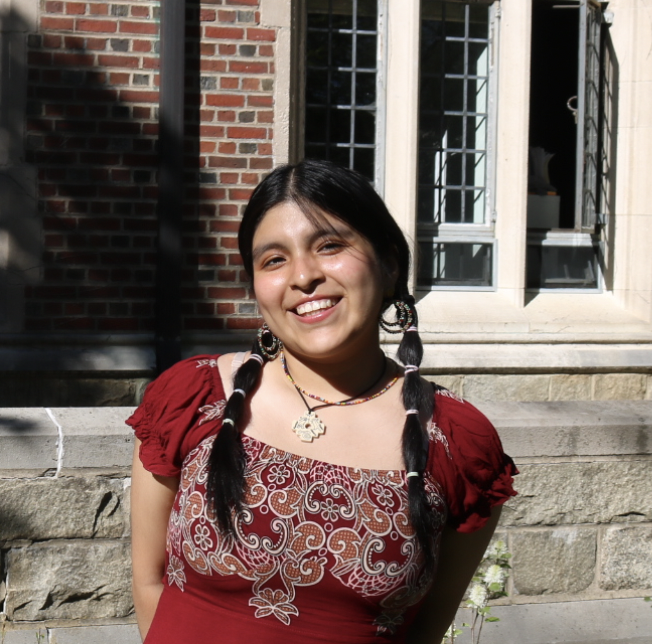
About the Author
Bela Sanchez Taipe is a first generation low income student recently graduated from Wellesley College with a major of Media Arts and Sciences. Her dream is to become an HCI university professor focus on designing human centered AI that enhances STEAM accessible education. This summer she is a Lulu Wang Scholar in Rockefeller University, where she is developing Bioinformatics introductory curriculum for Hunter College students. Outside of academics, she loves to share about Quechua language and culture through music, digital art and storytelling. As an international student from Perú, she loves to teach English as a second language, Computer Programming and host College counseling to peruvian young girls from low income backgrounds.
