![[DEFINE]: Our AI Futures](http://images.squarespace-cdn.com/content/v1/69c6d200c55e595fae9b42eb/cceee3eb-0a64-480a-a252-8300b82ce3ce/white_logo_edged.png?format=1500w)
Parshv Patel
I am learning to write for machines
before I know how to speak for myself
formatting my ambitions into bullet points
spacing the margins to a quarter-inch
so the parser can find what I am
before any person does.
This is how you enter now
not through a door held open by a stranger
not through a referral phoned in over coffee
but through an upload box, a thank you screen
a silence that promises it has received you
and will be in touch.
I grew up watching my mother work hard
On the bus home, her shoulders held the shape of rooms
I thought I will not inherit this.
I will learn the language of the room at the top of the building.
But the room at the top of the building
now has a new gatekeeper
and it does not speak in the language of ambition.
It speaks in keywords, in parsed syntax,
in a scoring rubric no one publishes
and no one challenges
because challenging a number feels like arguing with a fact.
I have read the research.
The models trained on historical hires
reproduce the biases of everyone who hired before them.
They have learned what a good candidate looks like
from a century of records
that told a specific story
about who belongs in a corner office
and who belongs outside it, making the windows shine.
My high school was Title I.
Half the seniors I knew didn't apply to four-year colleges
because no one explained the application.
They were not unambitious.
They were unformatted.
They did not know to put Python before programming
data analysis before spreadsheets
the same skills in the wrong dialect
filtered to the bottom of the pile
before any human blinked.
I think about them constantly
especially now that I am learning to build the systems
that will do this faster
with higher confidence intervals
with less margin for the kind of error
that is actually a form of grace.
I believe in some of what this technology can do.
I have read about diagnostic tools
that caught cancer on a chest scan in a rural clinic
on the one day a week the radiologist appeared.
I have watched a translation model
give language to a grandmother speaking Gujarati
in a clinic waiting room in Fresno,
where before she had only her grandson's imperfect memory of the words
his small voice reaching for what she needed to say.
I have used tools
that compressed twelve hours of reading
into two hours of real understanding,
and I am not ashamed.
Access is not nothing.
For people who started with less
a tool that levels the library is a form of justice.
But justice requires intention
and intention requires a human in the room.
In warehouses right now
workers are scored every minute
pick rate, idle time, a bathroom break
registered as deviation from expected output.
A supervisor who used to use judgment
has been given a dashboard instead.
The dashboard cannot see
that her hands are shaking
because she drove two hours to make this shift
after the babysitter cancelled
after her second job ran over
after she sat in her car for twenty minutes in the dark
talking herself into going inside.
The dashboard sees, she is 4.3% below average.
It does not see the 4.3%.
It sees the deviation.
It recommends action.
Action is taken.
And somewhere in San Francisco,
the developer who built the dashboard
is proud of what he has optimized.
The word optimize is doing a lot of work these days.
So is efficiency
So is scale
These words mean different things
depending on whether you are the one being scaled.
I am studying to be the developer.
I am also the child of someone
who would have been on the dashboard.
I do not know how to hold both things at once
without one of them breaking.
So I carry them both
and I call it double consciousness
and I call it data science
and neither name fits exactly.
There is a company. I will not name it
that uses AI to schedule shifts for retail workers.
The software does not know
that a shift starting at 6 a.m.
and a shift ending at 11 p.m. two nights before
is called a clopening
is called exhaustion
is called the reason people quit
who then get flagged by the algorithm
for high turnover, for unreliability,
their instability is becoming a score
that follows them to the next application
like a letter of reference
they were never allowed to read.
The gig economy runs on this logic
you are independent until the app decides otherwise.
You can set your hours until the surge window closes.
You have the freedom of a function called at runtime
with no guarantee of the next call.
I graduated valedictorian of a school
and arrived at Berkeley on scholarships
that required essays about my hardship
which I wrote well enough to win
but which no one should ever have to write
just to access what others receive without application.
Now I am in AI4ALL program
studying the technologies
that will decide who gets to work at all.
I am the candidate the algorithm approved.
I am also watching it quietly deny
everyone who looks like where I came from.
I do not want to build systems
that replace human judgment.
I want to build systems that restore it.
I want to build the tool
that tells a hiring manager
here is someone who would have been filtered out
look at what the filter missed.
I want to build the audit, the appeal,
the architecture of reconsideration.
I want to build technology that treats a worker's schedule
the way a good manager would
with knowledge of the commute, the childcare window,
the second job, the preference for consecutive days.
Not because it is efficient to be humane.
Because efficiency built on someone else's exhaustion
is not efficiency.
It is transfer.
And we should call it what it is.
I am standing at the entrance to a future
that has already written most of the terms.
I am learning to negotiate.
I am learning which systems deserve to be improved
and which ones need to be rebuilt from the ground up
with different data, different goals,
different questions asked at the very start
not how do we screen faster
but how do we see better.
The future of work is not a dashboard.
The future of work is not a deviation score.
The future of work is not a parser
that learns my keywords
before it learns my name.
The future of work is a room
where someone holds the door without being asked
where the coffee is still warm
where a human being looks up and says
tell me something the resume couldn't.
And the answer takes longer than thirty seconds.
And someone stays to hear it through.
I am learning to build toward that room.
I am learning which machines to trust
and which to question loudly
in public, with data and poetry both.
I am carrying two inheritances
the language of algorithms
and the knowledge of what it means
to press your palms against the glass
and hold them there
until the window holds your shape.
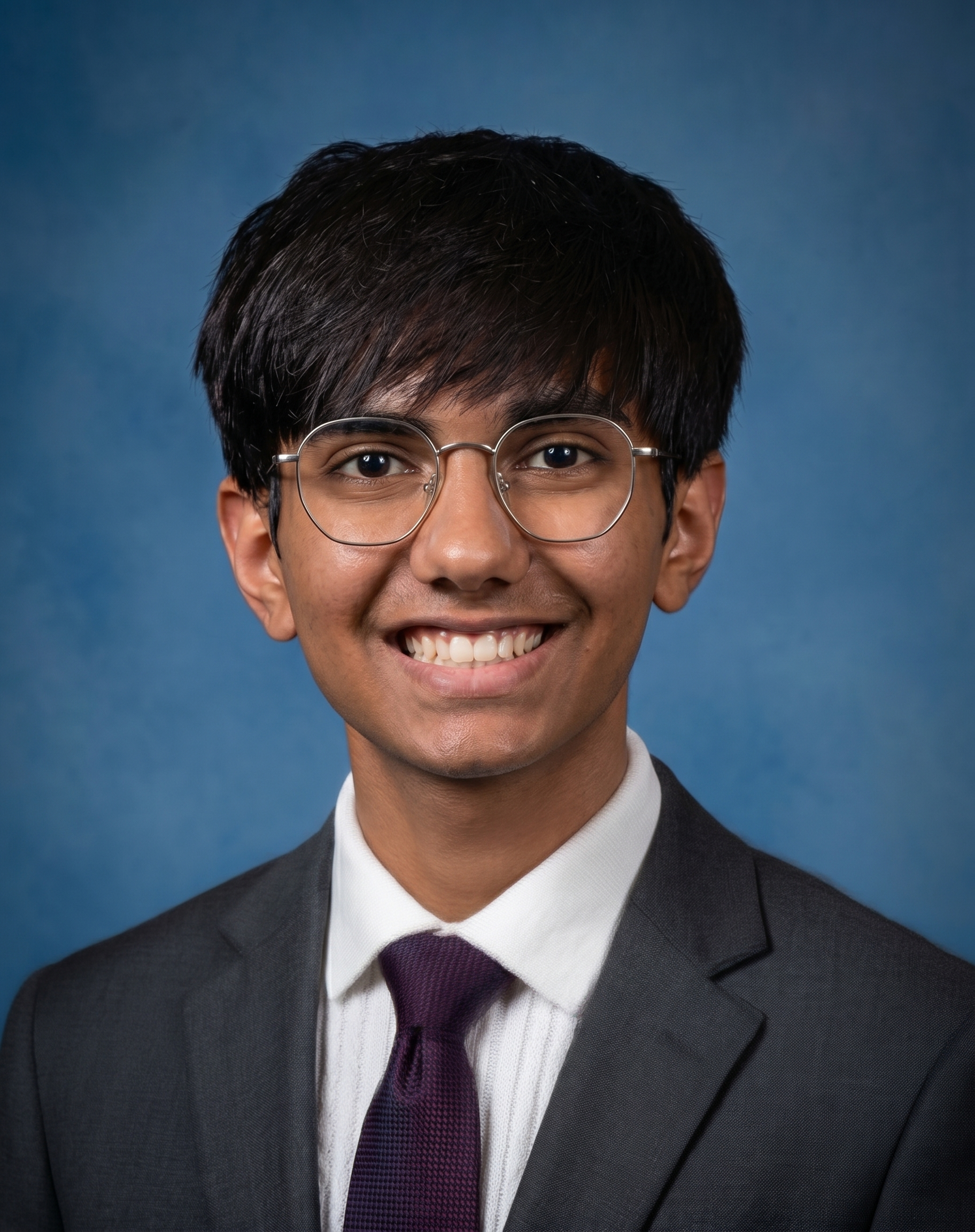
Meet the Author
Parshv Patel is a sophomore at UC Berkeley studying Data Science with 4.00 GPA, driven by a belief that technology should create opportunity for those often overlooked. After moving from India during high school and overcoming financial, cultural, and academic barriers, he graduated valedictorian and now studies data science to build ethical, human-centered AI systems. An Amazon Future Engineer Scholar, AI4All Ignite Fellow, Greenhouse Scholar, and researcher, he explores machine learning, data storytelling, and algorithmic fairness. Outside academics, he mentors students, plays tennis, and enjoys turning curiosity into impact for communities facing barriers similar to those he experienced growing up himself firsthand.
